|
Over the years, many figurines, pottery, wall paintings and other pictures
depicting dinosaurs, often together with other common animals and even men have
been found in various places around the world. Here are a few, many of which are
on display in various museums around the world. Predictably, evolutionists either
ignore or insist these are forgeries and frauds of creationists. As ridiculous as
this is, its
what they do. If men never saw living dinosaurs there would be no
pictographs of men hunting dinosaurs anywhere in the world, right? This
webpage will prove beyond doubt that there are many such pictographs and pottery
found all around the world. Lets start with this short YouTube video
showing pictographs of Amazon rainforest tribesmen hunting dinosaurs:

Amazon Pictographs

Folks, don't be fooled by people who are hell-bent on keeping you living in
ignorance, believing in the man-made myth of evolution. If these men
didn't see this dinosaur, how and why did they draw these pictures on the rocks?
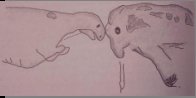
To the right is a picture of a dinosaur fighting a mammoth from the book Buried Alive
by Dr. Jack Cuozzo. It was taken by the author in
the Bernifal Cave, one of the caverns in France that is renowned for
Neanderthal artifacts. The cave has been closed to the public. Science News
was given the opportunity to publish the remarkable photo, but
declined. It seems that evidence against the prevailing paradigm of
naturalistic origin was selected against. It is buried alive by the
scientific establishment. As Cuozzo says, this is natural selection in
the most literal sense!
 "Fran Barnes, a recognized authority on rock art of the American
South-West, writes, 'In the San Rafael Swell, there is a pictograph
[picture symbol] that looks very much like a pterosaur, a Cretaceous
flying reptile'..." (Swift, Dennis, "Messages on Stone," Creation Ex Nihilo,
vol. 19, p. 20). This figure, about 7 feet long from wing-tip to
wing-tip, is actually painted with a dark-red pigment. Indians of the
Fremont culture are thought to have inhabited the "Swell" between 700
and 1250 A.D. Black Dragon Canyon is named for the pictograph which
resembles a large winged reptile with a headcrest. On the left is shown
a photo of one of the curious "dinosaur" petroglyphs near Middle Mesa
at the Wupatki National Park. This particular petroglyph is called
"Puff the Magic Dragon," and appears to be a depiction of a
fire-breathing dinosaur. Though there is no certain way to date such
petroglyphs, it is believed to be at least several hundred years old.
"Fran Barnes, a recognized authority on rock art of the American
South-West, writes, 'In the San Rafael Swell, there is a pictograph
[picture symbol] that looks very much like a pterosaur, a Cretaceous
flying reptile'..." (Swift, Dennis, "Messages on Stone," Creation Ex Nihilo,
vol. 19, p. 20). This figure, about 7 feet long from wing-tip to
wing-tip, is actually painted with a dark-red pigment. Indians of the
Fremont culture are thought to have inhabited the "Swell" between 700
and 1250 A.D. Black Dragon Canyon is named for the pictograph which
resembles a large winged reptile with a headcrest. On the left is shown
a photo of one of the curious "dinosaur" petroglyphs near Middle Mesa
at the Wupatki National Park. This particular petroglyph is called
"Puff the Magic Dragon," and appears to be a depiction of a
fire-breathing dinosaur. Though there is no certain way to date such
petroglyphs, it is believed to be at least several hundred years old.
  In 600 BC, under the reign of King Nebuchadnezzar, a Babylonian artist
was commissioned to shape reliefs of animals on the structures
associated with the Ishtar Gate. Centuries later, in 1887 AD, when
German archaeologist Robert Koldeway stumbled upon the blue-glazed
brick, that gate was rediscovered. The animals appear in alternating
rows with lions, fierce bulls (rimi or reems in Chaldean), and curious
long-necked dragons (sirrush). The lions and bulls would have been
present at that time in the Middle East. But, on what creature did the
ancient Babylonians model the dragon? The same word, sirrush, is
mentioned in the book of Bel and the Dragon, from the Apocrypha. Both
the description there and the image on these unearthed walls (see
right), which are now displayed in the Berlin Vorderasiatisches Museum,
appear to fit a sauropod dinosaur. (Shuker, Karl P.N., "The Sirrush of
Babylon," Dragons: A Natural History, 1995, pp. 70-73.)
In 600 BC, under the reign of King Nebuchadnezzar, a Babylonian artist
was commissioned to shape reliefs of animals on the structures
associated with the Ishtar Gate. Centuries later, in 1887 AD, when
German archaeologist Robert Koldeway stumbled upon the blue-glazed
brick, that gate was rediscovered. The animals appear in alternating
rows with lions, fierce bulls (rimi or reems in Chaldean), and curious
long-necked dragons (sirrush). The lions and bulls would have been
present at that time in the Middle East. But, on what creature did the
ancient Babylonians model the dragon? The same word, sirrush, is
mentioned in the book of Bel and the Dragon, from the Apocrypha. Both
the description there and the image on these unearthed walls (see
right), which are now displayed in the Berlin Vorderasiatisches Museum,
appear to fit a sauropod dinosaur. (Shuker, Karl P.N., "The Sirrush of
Babylon," Dragons: A Natural History, 1995, pp. 70-73.)
 The
ancient Sumatrans produced multiple pieces of art depicting
long-tailed, long-necked creatures with a headcrest. Some of these
animals resemble hadrosaurs. This particular work (Ethnographical
Museum, Budapest) depicts a creature that bears a striking resemblance
to a Corythosaurus which is being hunted by these ancient Indonesian
peoples. (Bodrogi, Tibor, Art of Indonesia, plate #10, 1973.) The
ancient Sumatrans produced multiple pieces of art depicting
long-tailed, long-necked creatures with a headcrest. Some of these
animals resemble hadrosaurs. This particular work (Ethnographical
Museum, Budapest) depicts a creature that bears a striking resemblance
to a Corythosaurus which is being hunted by these ancient Indonesian
peoples. (Bodrogi, Tibor, Art of Indonesia, plate #10, 1973.)

 Asian stories and stylized dragon depictions are fairly common. But an
unusual beaked dragon statue came up on the antiquities market and is
now in the Genesis Park collection. The bronze styling on this artifact
suggests it is from the Zhou Dynasty (1122 B.C. - 220 B.C.) or possibly
from the Han Dynasty (206 B.C. - 220 A.D.). It displays numerous
characteristics of the beaked dinosaurs (like the oviraptor depicted
alongside for comparison): tridactyl feet configuration, metatarsal
stance, scale-like representation all over the body (except for the
horn which has a striated pattern), long (albeit slender) tail,
elaborate head crest and a long neck. Another fascinating Chinese
artifact is the Late Eastern Zhou Sauropod (Fang Jian) Ornamental box.
Displaying a tridactyl foot, a long neck and a head that resembles a
brachiosaur, this depiction is compelling. (Fong, Wen ed., The Great Bronze Age of China, Metropolitan Museum of Art, 1980, p. 285.)
Asian stories and stylized dragon depictions are fairly common. But an
unusual beaked dragon statue came up on the antiquities market and is
now in the Genesis Park collection. The bronze styling on this artifact
suggests it is from the Zhou Dynasty (1122 B.C. - 220 B.C.) or possibly
from the Han Dynasty (206 B.C. - 220 A.D.). It displays numerous
characteristics of the beaked dinosaurs (like the oviraptor depicted
alongside for comparison): tridactyl feet configuration, metatarsal
stance, scale-like representation all over the body (except for the
horn which has a striated pattern), long (albeit slender) tail,
elaborate head crest and a long neck. Another fascinating Chinese
artifact is the Late Eastern Zhou Sauropod (Fang Jian) Ornamental box.
Displaying a tridactyl foot, a long neck and a head that resembles a
brachiosaur, this depiction is compelling. (Fong, Wen ed., The Great Bronze Age of China, Metropolitan Museum of Art, 1980, p. 285.)


 Next we consider a Shang dynasty (B.C. 1766-1122) dragon artifact that
was advertised on the Chinese antiquities market as a dinosaur
depiction. It displays relief lines in a scale-like pattern, a broad
beak, a dermal frill, and a headcrest that is strikingly like the
dinosaur Saurolophus (shown on the right). This jade statute, now in
the Genesis Park collection, is made of white colored nephrite with
differential weathering, cleaving veins and earth penetration,
demonstrating authenticity. (Click to enlarge.)
Next we consider a Shang dynasty (B.C. 1766-1122) dragon artifact that
was advertised on the Chinese antiquities market as a dinosaur
depiction. It displays relief lines in a scale-like pattern, a broad
beak, a dermal frill, and a headcrest that is strikingly like the
dinosaur Saurolophus (shown on the right). This jade statute, now in
the Genesis Park collection, is made of white colored nephrite with
differential weathering, cleaving veins and earth penetration,
demonstrating authenticity. (Click to enlarge.)
 The February 26, 2000 issue of Science News
contained an article that commenting on an artifact housed at the
Boston Museum of Fine Arts that has come to be known as the Hesione
vase (Hesman, 2000). Pictured on this ancient Greek vase is a series of
somewhat unusual paintings, including one that portrays a monster that
possesses the head of a dinosaur. This pottery was created around 550
B.C., and depicts the Greek hero Heracles rescuing Hesione from this
"monster of Troy." Forced to concede the amazingly realistic
dinosaurian depiction, Science News concluded that the paintings on this unusual vase simply prove that ancient people dug fossils, too. The February 26, 2000 issue of Science News
contained an article that commenting on an artifact housed at the
Boston Museum of Fine Arts that has come to be known as the Hesione
vase (Hesman, 2000). Pictured on this ancient Greek vase is a series of
somewhat unusual paintings, including one that portrays a monster that
possesses the head of a dinosaur. This pottery was created around 550
B.C., and depicts the Greek hero Heracles rescuing Hesione from this
"monster of Troy." Forced to concede the amazingly realistic
dinosaurian depiction, Science News concluded that the paintings on this unusual vase simply prove that ancient people dug fossils, too.
 To
the left is an urn from Caria, which was located in Asia Minor
(Turkey). This artifact (described in Thomas H. Carpenter's 1991 book Art and Myth in Ancient Greece: A Handbook)
is estimated to be from 530 BC. It depicts what appears to be a
mosasaurus with several known sea creatures. The animal behind the sea
serpent is a seal, while an octopus is below the sea serpent along with
what seems to be a dolphin. The thick jaws, big teeth, large eyes, and
positioning of the flippers on this creature match a mosasaurus
skeleton very well. Some mosasaurus species also had a narrow cranial
crest behind the eye that may have had a fin attached the way it is
depicted on the Carian urn. Other artifacts of interest from this
region came to light after the deluge and landslide of 1971 in the
small village of Girifalco. A lawyer named Mario Tolone began
investigating. Tolone asserts to have found dinosaurian representations
in this area of Caria with hundreds of other ancient artifacts, of a
pre-Greek civilization of Calabria, that is at least 3000 years old.
Click here to view a page
dedicated to this find. To
the left is an urn from Caria, which was located in Asia Minor
(Turkey). This artifact (described in Thomas H. Carpenter's 1991 book Art and Myth in Ancient Greece: A Handbook)
is estimated to be from 530 BC. It depicts what appears to be a
mosasaurus with several known sea creatures. The animal behind the sea
serpent is a seal, while an octopus is below the sea serpent along with
what seems to be a dolphin. The thick jaws, big teeth, large eyes, and
positioning of the flippers on this creature match a mosasaurus
skeleton very well. Some mosasaurus species also had a narrow cranial
crest behind the eye that may have had a fin attached the way it is
depicted on the Carian urn. Other artifacts of interest from this
region came to light after the deluge and landslide of 1971 in the
small village of Girifalco. A lawyer named Mario Tolone began
investigating. Tolone asserts to have found dinosaurian representations
in this area of Caria with hundreds of other ancient artifacts, of a
pre-Greek civilization of Calabria, that is at least 3000 years old.
Click here to view a page
dedicated to this find.


 Shown to the left is a terracotta statue measuring about 18 cm long,
shaped remarkably like a dinosaur with plates on its back. The plates
are triangular, and continue along the back until reaching the tail. In
the view from above (right) the object reveals a strange curving of the
plates, as if the animal had been represented in motion on the land.
The legs are large and awkward, as if carrying great weight, not at all
like those of a lizard. There is also a clear representation of a
stegosaurus on a piece of broken pottery.
Shown to the left is a terracotta statue measuring about 18 cm long,
shaped remarkably like a dinosaur with plates on its back. The plates
are triangular, and continue along the back until reaching the tail. In
the view from above (right) the object reveals a strange curving of the
plates, as if the animal had been represented in motion on the land.
The legs are large and awkward, as if carrying great weight, not at all
like those of a lizard. There is also a clear representation of a
stegosaurus on a piece of broken pottery.
The art below is from a Mesopotamian cylinder seal dated at 3300 BC. (Moortgart, Anton, The Art of Ancient Mesopotamia,
1969, plate 292.) The animal on the right is an artists conception from
a skeleton of an Apatosaurus. There are many striking similarities
between these two depictions. The legs and feet on the Egyptian art
clearly fit the sauropods better than any other type of animal. The
biggest difference is at the head. Cartilage forming the shape of a
frill or ears may be stylized or accurate (since there is no way to
know from the skeletons we have today). As for the musculature, the
Egyptian artist draws with stunning realism. One has to ask where the
artist got the model to draw so convincingly the trunk of a sauropod? 

 An Egyptian seal with the cartouche (official name inscribed within an
oval) of Tutmosis III (appx. 1400 B.C.) depicts a Sauropterygia-like
animal (type of plesiosaur). The anterior and posterior flippers are
distinctively represented with the narrow connection to the rotund body
of the creature. The seal is from the Mitry collection and is of
unquestioned authenticity. The ancient Egyptians are known for their
keen observation and accurate zoological
An Egyptian seal with the cartouche (official name inscribed within an
oval) of Tutmosis III (appx. 1400 B.C.) depicts a Sauropterygia-like
animal (type of plesiosaur). The anterior and posterior flippers are
distinctively represented with the narrow connection to the rotund body
of the creature. The seal is from the Mitry collection and is of
unquestioned authenticity. The ancient Egyptians are known for their
keen observation and accurate zoological
 representations, particularly with regard to sea creatures. Other such seals in
  the
Mitry collection appear to have dinosaurian representations as well.
The world famous gold throne of King Tut (right) has winged serpents
forming the arm rests. Known as Wadjet, the winged serpent of Egypt,
protected the Pharaohs and controlled the waters of the Nile. In fact,
winged snakes are depicted on many of the coffins from ancient Egypt.
To the lower right is a picture of a winged serpent like a "covering
saraph" protecting the god Osiris. There is even a hieroglyphic symbol
for the winged serpent that appears in the Egyptian Book of the Dead.
(Note the hieroglyphic in the picture on this limestone pendant to the
lower left.) the
Mitry collection appear to have dinosaurian representations as well.
The world famous gold throne of King Tut (right) has winged serpents
forming the arm rests. Known as Wadjet, the winged serpent of Egypt,
protected the Pharaohs and controlled the waters of the Nile. In fact,
winged snakes are depicted on many of the coffins from ancient Egypt.
To the lower right is a picture of a winged serpent like a "covering
saraph" protecting the god Osiris. There is even a hieroglyphic symbol
for the winged serpent that appears in the Egyptian Book of the Dead.
(Note the hieroglyphic in the picture on this limestone pendant to the
lower left.)
 The January 2003 issue of National Geographic
magazine presents an artifact described as a "cosmetic palette . . .
from a cemetery of the first dynasties in Manshaat Ezzat." These
long-necked creatures displayed on page 78 fit the pattern of other
ancient dinosaur-like depictions, including arching, muscular necks and
stout bodies. Known as the "Two Dog Palette," this artifact depicts
many lifelike animals (including a giraffe on the reverse).
The January 2003 issue of National Geographic
magazine presents an artifact described as a "cosmetic palette . . .
from a cemetery of the first dynasties in Manshaat Ezzat." These
long-necked creatures displayed on page 78 fit the pattern of other
ancient dinosaur-like depictions, including arching, muscular necks and
stout bodies. Known as the "Two Dog Palette," this artifact depicts
many lifelike animals (including a giraffe on the reverse).
  To
the right are displayed slate palettes from Hierakonpolis showing the
triumph of King Nar-mer with long necked dragons and an ancient palette
depicting a pair of "dinosaur-like" creatures along with numerous clear
representations of living animals (taken from p. 93 of Pritchard's book
The Ancient Near East in Pictures). To
the right are displayed slate palettes from Hierakonpolis showing the
triumph of King Nar-mer with long necked dragons and an ancient palette
depicting a pair of "dinosaur-like" creatures along with numerous clear
representations of living animals (taken from p. 93 of Pritchard's book
The Ancient Near East in Pictures).
The preponderance of these long-necked depictions in ancient art (note
also the Egyptian wand depiction) motivated archaeologists who do not
believe men and dinosaurs coexisted to invent a name for this
particular creature. It is called a "serpopard," supposedly a mosaic of
a serpent and a leopard. But for those who believe that man was created
in the beginning alongside the great reptiles, these palettes seem to
be an attempt to depict a sauropod dinosaur. Note the "Four Dogs
Palette" with the "serpopard" cut out for clarity.


To the right is a Roman mosaic from about 200 AD that depicts two long-necked sea dragons. Paul Taylor, author of The Great Dinosaur Mystery and the Bible, likens them to the web-footed Tanystropheus shown beside.
 To
the left is another beautiful mosaic that was one of the wonders of the
second century world. Called the Nile Mosaic of Palestrina, it depicts
Nile scenes from Egypt all the way to Ethiopia. Scholars now believe
this is the work of Demetrius the Topographer, an artist from
Alexandria who came to work in Rome. The top portion of this remarkable
piece of art is generally believed to depict African animals being
hunted by black-skinned warriors. These Ethiopians are pursuing what
appears to be some type of dinosaur. The Greek Letters above the
reptilian animal in question are: KROKODILOPARDALIS which is literally
translated Crocodile-Leopard. The picture shown here is only a small
portion of the massive mosaic. It also contains clear depictions of
known animals, including Egyptian crocodiles and hippos. (Finley, The Light of the Past, 1965, p. 93.) To
the left is another beautiful mosaic that was one of the wonders of the
second century world. Called the Nile Mosaic of Palestrina, it depicts
Nile scenes from Egypt all the way to Ethiopia. Scholars now believe
this is the work of Demetrius the Topographer, an artist from
Alexandria who came to work in Rome. The top portion of this remarkable
piece of art is generally believed to depict African animals being
hunted by black-skinned warriors. These Ethiopians are pursuing what
appears to be some type of dinosaur. The Greek Letters above the
reptilian animal in question are: KROKODILOPARDALIS which is literally
translated Crocodile-Leopard. The picture shown here is only a small
portion of the massive mosaic. It also contains clear depictions of
known animals, including Egyptian crocodiles and hippos. (Finley, The Light of the Past, 1965, p. 93.)
"An
ancient Mayan relief sculpture of a peculiar bird with reptilian
characteristics has been discovered in Totonacapan, in northeastern
section of Veracruz, Mexico. José Diaz-Bolio, a Mexican
archaeologist-journalist responsible for the discovery, says there is
evidence that the serpent-bird sculpture, located in the ruins of
Tajín, is not merely the product of Mayan flights of fancy, but a
realistic representation of an animal that lived during the period of
the ancient Mayans - 1,000 to 5,000 years ago. If indeed such
serpent-birds were contemporary with the ancient Mayan culture, the
relief sculpture represents a startling evolutionary oddity. Animals
with such characteristics are believed to have disappeared 130 million
years ago." (Anonymous, "Serpent-Bird of the Mayans," Science Digest, vol. 64 November 1968, p. 1)
 
The picture to the right (click to enlarge) was drawn by North American
Anasazi Indians that lived in the area that has now become Utah
approximately 150 B.C. - 1200 A.D. Even noted anti-creationists agree
that it resembles a dinosaur and that the brownish film which has
hardened over the picture, along with the pitting and weathering,
attests to its age.  One
evolutionist writes, "There is a petroglyph in Natural Bridges National
Monument that bears a startling resemblance to a dinosaur, specifically
a Brontosaurus, with a long tail and neck, small head and all." (Barnes
and Pendleton, Canyon Country Prehistoric Indians - Their Culture, Ruins, Artifacts and Rock Art,
1995.) Clearly a native warrior and an apatosaur-like creature are
depicted. Horned and flying serpent figures are prominent in the
mythology of most Native American peoples, often associated with rain
and thunder. An example is the Algonquin pictograph of a flying serpent
known as Mishipizheu. Yet another Native American rock pictograph found
in Utah (see left) seems to depict a sauropod dinosaur. One
evolutionist writes, "There is a petroglyph in Natural Bridges National
Monument that bears a startling resemblance to a dinosaur, specifically
a Brontosaurus, with a long tail and neck, small head and all." (Barnes
and Pendleton, Canyon Country Prehistoric Indians - Their Culture, Ruins, Artifacts and Rock Art,
1995.) Clearly a native warrior and an apatosaur-like creature are
depicted. Horned and flying serpent figures are prominent in the
mythology of most Native American peoples, often associated with rain
and thunder. An example is the Algonquin pictograph of a flying serpent
known as Mishipizheu. Yet another Native American rock pictograph found
in Utah (see left) seems to depict a sauropod dinosaur.
 The
native American Coclé culture of Panama was discovered by A. Hyatt
Verrill. He noticed the oddly pterosaur-like representations on Coclé
pottery and suggested it was so realistic that these native Americans
must have been influenced by fossil discoveries. He describes the
depiction (see left) as having "beak-like jaws armed with sharp teeth,
wings with two curved claws, short, pointed tail, reptilian head crest
or appendages, and strong hind feet with five-clawed toes on each." The
Coclé civilization dates from AD 1330-1520. But Verrill theorizes that
such drawings were based on "accurate descriptions, or even drawings or
carvings, of fossilized pterodayctyls" (Verrill, A. Hyatt, Strange Prehistoric Animals and their Stories, 1948, pp. 132-133.) The
native American Coclé culture of Panama was discovered by A. Hyatt
Verrill. He noticed the oddly pterosaur-like representations on Coclé
pottery and suggested it was so realistic that these native Americans
must have been influenced by fossil discoveries. He describes the
depiction (see left) as having "beak-like jaws armed with sharp teeth,
wings with two curved claws, short, pointed tail, reptilian head crest
or appendages, and strong hind feet with five-clawed toes on each." The
Coclé civilization dates from AD 1330-1520. But Verrill theorizes that
such drawings were based on "accurate descriptions, or even drawings or
carvings, of fossilized pterodayctyls" (Verrill, A. Hyatt, Strange Prehistoric Animals and their Stories, 1948, pp. 132-133.)
  Another petroglyph (carved rock drawing) has been found in Arizona's
Havasupai Canyon (photo taken by Dr. DeLancy). In the far right
picture, Paul Taylor compares this ancient drawing to the Edmontosaurus.
Another petroglyph (carved rock drawing) has been found in Arizona's
Havasupai Canyon (photo taken by Dr. DeLancy). In the far right
picture, Paul Taylor compares this ancient drawing to the Edmontosaurus.
 There
are stories of a plesiosaur-like creature seen in Queensland,
Australia. Both aboriginal peoples around Lake Galilee and tribes
farther up to the north tell of a long-necked animal with a large body
and flippers. "Elders of the Kuku Yalanji aboriginal tribe of Far North
Queensland, Australia, relate stories of Yarru (or Yarrba), a creature
which used to inhabit rain forest water holes. The painting [left]
depicts a creature with features remarkably similar to a plesiosaur. It
even shows an outline of the gastro-intestinal tract, indicating that
these animals had been hunted and butchered." (CEN Technical Journal, Vol.12, No. 3, 1998, p. 345.) There
are stories of a plesiosaur-like creature seen in Queensland,
Australia. Both aboriginal peoples around Lake Galilee and tribes
farther up to the north tell of a long-necked animal with a large body
and flippers. "Elders of the Kuku Yalanji aboriginal tribe of Far North
Queensland, Australia, relate stories of Yarru (or Yarrba), a creature
which used to inhabit rain forest water holes. The painting [left]
depicts a creature with features remarkably similar to a plesiosaur. It
even shows an outline of the gastro-intestinal tract, indicating that
these animals had been hunted and butchered." (CEN Technical Journal, Vol.12, No. 3, 1998, p. 345.)
  There
are some clearly ancient engravings in dolerite and gneiss that have
been found in Bushmanland, South Africa. Amongst the many depictions,
dinosaur footprints, and other artifacts in this region; two are of
special interest. One resembles a sauropod dinosaur and the other looks
like an attempt to depict a pterosaur. There
are some clearly ancient engravings in dolerite and gneiss that have
been found in Bushmanland, South Africa. Amongst the many depictions,
dinosaur footprints, and other artifacts in this region; two are of
special interest. One resembles a sauropod dinosaur and the other looks
like an attempt to depict a pterosaur.
 An Egyptian seal (right) depicts a large pterosaur hunting a gazelle (Giveon, R., "Scarabs From Recent Excavations in Israel," Orbis Biblicus et Orientalis
83, 1988, p. 70.) The leaf shaped tail vane of the pterosaur is
unmistakable. The long reptilian head has the double crest of a
Scaphognathus above it. The two wings even exhibit the unique
corrugated features seen in the Solnhofen Rhamphorhynchus fossil and
the claws of a pterosaur. The level of detail is similar to that for
the gazelle. The seal dates from 1300-1150 B.C. and is now in the Tel
Aviv University's Institute of Archaeology. Similarly, an Egyptian
statue residing in a Berlin museum depicts legs with toes and claws,
three wing claws; a prototagium (a portion of the wing above the arm
known from pterosaur fossil impressions); and a tail vane. That
pterosaur is shown hunting a falcon and also appeared to have the
dental structure of a Scaphognathus. (Goertzen, John, "The
Rhamphorhynchoid Pterosaur Scaphognathus crassirostris: A 'Living
Fossil' Until the 17th Century," 1998 ICC Paper.) An Egyptian seal (right) depicts a large pterosaur hunting a gazelle (Giveon, R., "Scarabs From Recent Excavations in Israel," Orbis Biblicus et Orientalis
83, 1988, p. 70.) The leaf shaped tail vane of the pterosaur is
unmistakable. The long reptilian head has the double crest of a
Scaphognathus above it. The two wings even exhibit the unique
corrugated features seen in the Solnhofen Rhamphorhynchus fossil and
the claws of a pterosaur. The level of detail is similar to that for
the gazelle. The seal dates from 1300-1150 B.C. and is now in the Tel
Aviv University's Institute of Archaeology. Similarly, an Egyptian
statue residing in a Berlin museum depicts legs with toes and claws,
three wing claws; a prototagium (a portion of the wing above the arm
known from pterosaur fossil impressions); and a tail vane. That
pterosaur is shown hunting a falcon and also appeared to have the
dental structure of a Scaphognathus. (Goertzen, John, "The
Rhamphorhynchoid Pterosaur Scaphognathus crassirostris: A 'Living
Fossil' Until the 17th Century," 1998 ICC Paper.)
Deep in the jungles of Cambodia are ornate temples and palaces from the Khmer civilization. 
 One
such temple, Ta Prohm abounds with stone statues and reliefs. Almost
every square inch of the gray sandstone is covered with ornate,
detailed carvings. These depict familiar animals like monkeys, deer,
water buffalo, parrots, and lizards. However, one column contains an
intricate carving of a stegosaur-like creature. But how could artisans
decorating an 800 year old Buddhist temple know what a dinosaur looked
like? Western science only began assembling dinosaurs skeletons in the
past two centuries. (Pictures are courtesy of Don Patton.) One
such temple, Ta Prohm abounds with stone statues and reliefs. Almost
every square inch of the gray sandstone is covered with ornate,
detailed carvings. These depict familiar animals like monkeys, deer,
water buffalo, parrots, and lizards. However, one column contains an
intricate carving of a stegosaur-like creature. But how could artisans
decorating an 800 year old Buddhist temple know what a dinosaur looked
like? Western science only began assembling dinosaurs skeletons in the
past two centuries. (Pictures are courtesy of Don Patton.)
 European reports of flying serpent living in Egypt persist through the
1600's. The Italian naturalist Prosper Alpin wrote a fascinating
natural history of Egypt in the 1580's. He describes their crest, a
small piece of skin on the head, their tail being "thick as a finger,"
their length being "as long as a palm branch," and their leaf-shaped
tail. (Alpin, P., Histoire Naturelle de l'Egypte,
tr. by R. de Fenoyl, 1979, pp. 407-409.) All is precisely like modern
fossil reconstructions. A French wooden image, dating from the 16th
century, also displays remarkable features of a pterosaur. There are
two wings that clearly appear to have ribbed membranes rather than
feathers. There appears to be a small head crest above and slightly in
front of the eyes, the distinctive tail vane, and a hint of the twin
skin flap above and behind the bony crest that is quite like the
Egyptian seal.
European reports of flying serpent living in Egypt persist through the
1600's. The Italian naturalist Prosper Alpin wrote a fascinating
natural history of Egypt in the 1580's. He describes their crest, a
small piece of skin on the head, their tail being "thick as a finger,"
their length being "as long as a palm branch," and their leaf-shaped
tail. (Alpin, P., Histoire Naturelle de l'Egypte,
tr. by R. de Fenoyl, 1979, pp. 407-409.) All is precisely like modern
fossil reconstructions. A French wooden image, dating from the 16th
century, also displays remarkable features of a pterosaur. There are
two wings that clearly appear to have ribbed membranes rather than
feathers. There appears to be a small head crest above and slightly in
front of the eyes, the distinctive tail vane, and a hint of the twin
skin flap above and behind the bony crest that is quite like the
Egyptian seal.
 The
next drawing is from a 17th century German tract about the dangers of
witches and witchcraft. Witches are accused of causing houses to
spontaneously combust. The pterosaurs depicted flying in the
background, with characteristic headcrests and tails, were apparently
associated with witches. (Guazzo, Francesco Maria, Compendium Maleficarum,
1628, p. 23.) Many accounts from that time period describe creatures
that sound suspiciously like pterodactyls. An official government
report from 1793 states: "In the end of November and beginning of
December last, many of the country people observed dragons appearing in
the north and flying rapidly towards the east; from which they
concluded, and their conjectures were right, that...boisterous weather
would follow." ("Flying Dragons at Aberdeen," A Statistical Account of Scotland, 1793, p. 467.) The
next drawing is from a 17th century German tract about the dangers of
witches and witchcraft. Witches are accused of causing houses to
spontaneously combust. The pterosaurs depicted flying in the
background, with characteristic headcrests and tails, were apparently
associated with witches. (Guazzo, Francesco Maria, Compendium Maleficarum,
1628, p. 23.) Many accounts from that time period describe creatures
that sound suspiciously like pterodactyls. An official government
report from 1793 states: "In the end of November and beginning of
December last, many of the country people observed dragons appearing in
the north and flying rapidly towards the east; from which they
concluded, and their conjectures were right, that...boisterous weather
would follow." ("Flying Dragons at Aberdeen," A Statistical Account of Scotland, 1793, p. 467.)
 A
dragon was said to live in the wetlands near Rome in December of 1691.
This creature lived in a cave and supposedly terrorized the local
population. A sketch of the skeleton has survived in the possession of
Ingegniero Cornelio Meyer (right). The most remarkable thing about the
animal is the clear head crest and the dual piece of skin from the
crest. Five digits were clearly visible for each foot, of the proper
length and with the first shorter and offset from the rest as is proper
for the Scaphognathus. There is a hint of a wing claw on the far wing
where it curves forward. The membraned wings are in front of the legs,
on the vertebrae, matching the fossils. The femur is properly shown as
a single bone. The tibia and fibula, the twin lower leg bones, are
visible too. Although some have suggested that it could be a fossil or
a faked composite, it is much too accurate to be a fabrication. The
survival of the skin suggests that it is not a fossil since it includes
accurate wing features, a head crest, and the ears. (Goertzen, John,
"The Rhamphorhynchoid Pterosaur Scaphognathus crassirostris: A 'Living Fossil' Until the 17th Century," 1998 ICC Paper.) A
dragon was said to live in the wetlands near Rome in December of 1691.
This creature lived in a cave and supposedly terrorized the local
population. A sketch of the skeleton has survived in the possession of
Ingegniero Cornelio Meyer (right). The most remarkable thing about the
animal is the clear head crest and the dual piece of skin from the
crest. Five digits were clearly visible for each foot, of the proper
length and with the first shorter and offset from the rest as is proper
for the Scaphognathus. There is a hint of a wing claw on the far wing
where it curves forward. The membraned wings are in front of the legs,
on the vertebrae, matching the fossils. The femur is properly shown as
a single bone. The tibia and fibula, the twin lower leg bones, are
visible too. Although some have suggested that it could be a fossil or
a faked composite, it is much too accurate to be a fabrication. The
survival of the skin suggests that it is not a fossil since it includes
accurate wing features, a head crest, and the ears. (Goertzen, John,
"The Rhamphorhynchoid Pterosaur Scaphognathus crassirostris: A 'Living Fossil' Until the 17th Century," 1998 ICC Paper.)
 In 1704, Hœllischer Morpheus:Saducismus Triumphatus
was published, the theme of this work was the grotesque (including
subjects like the occult and black arts). No doubt because the Bible
referred to Satan as "that old dragon," dragons are among the creatures
often encountered in such works. Within this volume are drawings which
depict flying dragons containing actual morphological features of
certain species of pterosaurs. On the frontispiece of the work is a
clear depiction of a long tailed pterosaur represented with two feet,
wings, and a snake-like tail ending in a tail vane. In 1704, Hœllischer Morpheus:Saducismus Triumphatus
was published, the theme of this work was the grotesque (including
subjects like the occult and black arts). No doubt because the Bible
referred to Satan as "that old dragon," dragons are among the creatures
often encountered in such works. Within this volume are drawings which
depict flying dragons containing actual morphological features of
certain species of pterosaurs. On the frontispiece of the work is a
clear depiction of a long tailed pterosaur represented with two feet,
wings, and a snake-like tail ending in a tail vane.
 Choir
stall railings and misericords (shelf-like seats for reclining while
standing) in medieval European churches are often adorned with ornate
carvings. A common theme is the depictions of a dragon (symbolizing
Satan) fighting a lion (symbolizing Christ). To the right is one such
depiction, showing a dragon that looks very much like a sauropod
dinosaur. Choir
stall railings and misericords (shelf-like seats for reclining while
standing) in medieval European churches are often adorned with ornate
carvings. A common theme is the depictions of a dragon (symbolizing
Satan) fighting a lion (symbolizing Christ). To the right is one such
depiction, showing a dragon that looks very much like a sauropod
dinosaur.
"A fantastic mystery has developed over a set of cave paintings found
in the Gorozomzi Hills, 25 miles from Salisbury. For the paintings
include a brontosaurus - the 67-foot, 30-ton-like creature scientists
believed became extinct millions of years before man appeared on earth.
Yet the bushmen who did the paintings ruled Rhodesia from only 1500
b.c. until a couple of hundred years ago. And the experts agree that
the bushmen always painted from life.  This belief is borne out by other Gorozomzi Hills cave paintings -
accurate representations of the elephant, hippo, buck and giraffe. The
mysterious pictures were found by Bevan Parkes, who owns the land the
caves are on. Adding to the puzzle of the rock paintings found by
Parkes is a drawing of a dancing bear. As far as scientists know, bears
have never lived in Africa." (Anonymous, "Bushmen's Paintings Baffling
to Scientists," Evening News, January 1, 1970, London Express Service,
printed in Los Angeles Herald-Examiner,
January 7, 1970.) To the left is just such a rock painting from a cave
at Nachikufu near Mpika in northern Zimbabwe (formerly Rhodesia). It
shows three long-necked, long-tailed creatures sketched in white.
(Clark, Desmond J., The Rock Paintings of Northern Rhodesia and Nyasaland, in Summers, Rogers, Rock Art of Central Africa, 1959, pp. 28-29, 194.)
This belief is borne out by other Gorozomzi Hills cave paintings -
accurate representations of the elephant, hippo, buck and giraffe. The
mysterious pictures were found by Bevan Parkes, who owns the land the
caves are on. Adding to the puzzle of the rock paintings found by
Parkes is a drawing of a dancing bear. As far as scientists know, bears
have never lived in Africa." (Anonymous, "Bushmen's Paintings Baffling
to Scientists," Evening News, January 1, 1970, London Express Service,
printed in Los Angeles Herald-Examiner,
January 7, 1970.) To the left is just such a rock painting from a cave
at Nachikufu near Mpika in northern Zimbabwe (formerly Rhodesia). It
shows three long-necked, long-tailed creatures sketched in white.
(Clark, Desmond J., The Rock Paintings of Northern Rhodesia and Nyasaland, in Summers, Rogers, Rock Art of Central Africa, 1959, pp. 28-29, 194.)

 Iron sculptures made by the Bambara peoples of Mali Africa in the
1800's display a three-horned creature with what appears to be a neck
frill. The specimens shown here, part of Genesis Park's collection,
exhibit dinosaurian characteristics. One shows top horns pointed
forward and the neck frill extending halfway down the animal's back,
much like the ceratopsian dinosaur Chasmosaurus. The long tail, squat
arched body, and sprawled legs also give it the appearance of a
ceratopsian dinosaur. The second, entitled "dinosaurian sculpture," by
the exhibiting gallery shows a four-legged creature with a long neck
and tail like a sauropod dinosaur. The neck has a slight widening and a
ridged frill that makes it a fascinating depiction.
Iron sculptures made by the Bambara peoples of Mali Africa in the
1800's display a three-horned creature with what appears to be a neck
frill. The specimens shown here, part of Genesis Park's collection,
exhibit dinosaurian characteristics. One shows top horns pointed
forward and the neck frill extending halfway down the animal's back,
much like the ceratopsian dinosaur Chasmosaurus. The long tail, squat
arched body, and sprawled legs also give it the appearance of a
ceratopsian dinosaur. The second, entitled "dinosaurian sculpture," by
the exhibiting gallery shows a four-legged creature with a long neck
and tail like a sauropod dinosaur. The neck has a slight widening and a
ridged frill that makes it a fascinating depiction.
 Another
African tribe from the Mali region is known for producing dinosaurian
objects in the mid-1800's . This is the same timeframe when Sir Richard
Owen coined the term dinosaur in England. The bronze artifact to the
left shows a Dogon tribesman riding a long-necked, long-tailed
reptilian creature. The oddly bird-like head with strong jawline is
reminiscent of the "duck bill" on certain Ornithopod dinosaurs. The
diamond-shaped pattern on the skin matches fossilized skin impressions
discovered on a hadrosaur in southern Utah. Another
African tribe from the Mali region is known for producing dinosaurian
objects in the mid-1800's . This is the same timeframe when Sir Richard
Owen coined the term dinosaur in England. The bronze artifact to the
left shows a Dogon tribesman riding a long-necked, long-tailed
reptilian creature. The oddly bird-like head with strong jawline is
reminiscent of the "duck bill" on certain Ornithopod dinosaurs. The
diamond-shaped pattern on the skin matches fossilized skin impressions
discovered on a hadrosaur in southern Utah.

 In
1924 some Roman style lead artifacts were excavated near Tucson, AZ
(see right). Described on p. 331 of David Hatcher's book The Lost Cities of North & Central America
is the unique carvings on these implements, particularly a clear
dinosaur depiction on a sword. The Arizona Historical Society still has
the sword. In
1924 some Roman style lead artifacts were excavated near Tucson, AZ
(see right). Described on p. 331 of David Hatcher's book The Lost Cities of North & Central America
is the unique carvings on these implements, particularly a clear
dinosaur depiction on a sword. The Arizona Historical Society still has
the sword.
  A plated and horned creature has also been discovered in Cree Indian
art (far left) on the Agawa Rock at Misshepezhieu, Lake Superior
Provincial Park, Ontario, Canada. Also to the left is pictured an Inca
Ceremonial Burial Stones that is likely from the Nazca culture. In 1571
the Spanish conquistadors brought back stories that there were stones
with strange creatures carved on them found in this region of Peru.
Today, over 1100 such stones were found by Dr. Javier Cabrera.
A plated and horned creature has also been discovered in Cree Indian
art (far left) on the Agawa Rock at Misshepezhieu, Lake Superior
Provincial Park, Ontario, Canada. Also to the left is pictured an Inca
Ceremonial Burial Stones that is likely from the Nazca culture. In 1571
the Spanish conquistadors brought back stories that there were stones
with strange creatures carved on them found in this region of Peru.
Today, over 1100 such stones were found by Dr. Javier Cabrera. 

 In the early 1930's, his father found many of these ceremonial burial
stones in Ica's numerous Peruvian tombs and noted that dinosaur-like
creatures were represented on some of them. Retired from the University
of Lima, Dr. Cabrera had focused upon validating these finds within the
scientific community. His credibility was strengthened by long-necked
creatures displayed on pottery in the museum of Lima and beautiful
tapestries from the Nazca tombs (ca 700 AD) with a repeating pattern
that looks like dinosaurs. Indeed, the depictions on some of the Ica
Stones show the sauropod dinosaurs with a crest of spines much like
that discovered by Paleontologist Stephen Czerkas. "Recent discovery of fossilized sauropod (diplodocid)
skin impressions reveals a significantly different appearance for these
dinosaurs.
In the early 1930's, his father found many of these ceremonial burial
stones in Ica's numerous Peruvian tombs and noted that dinosaur-like
creatures were represented on some of them. Retired from the University
of Lima, Dr. Cabrera had focused upon validating these finds within the
scientific community. His credibility was strengthened by long-necked
creatures displayed on pottery in the museum of Lima and beautiful
tapestries from the Nazca tombs (ca 700 AD) with a repeating pattern
that looks like dinosaurs. Indeed, the depictions on some of the Ica
Stones show the sauropod dinosaurs with a crest of spines much like
that discovered by Paleontologist Stephen Czerkas. "Recent discovery of fossilized sauropod (diplodocid)
skin impressions reveals a significantly different appearance for these
dinosaurs. 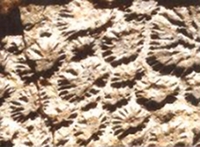 The
fossilized skin demonstrates that a median row of spines was present...
Some are quite narrow, and others are broader and more conical." (Geology,
"New Look for Sauropod Dinosaurs," December, 1992, p. 1,068.)" Also, of
interest is the fact that the skin of many of the carved dinosaurs has
rounded bump-like depictions. Some scientists had pointed to this as
evidence that these stones were not scientifically accurate. However,
more recent discoveries of fossilized dinosaur skin and embryos have
silenced these same critics. For example, Luis Chiappe and colleagues
discussed certain sauropod dinosaur embryos found in South America:
"The general skin pattern consists of round, non-overlapping,
tubercle-like scales...A rosette pattern of scales is present in
PVPH-130" (Chiappe, et al., 1998, p. 259). Note the skin depiction
above to the left. The
fossilized skin demonstrates that a median row of spines was present...
Some are quite narrow, and others are broader and more conical." (Geology,
"New Look for Sauropod Dinosaurs," December, 1992, p. 1,068.)" Also, of
interest is the fact that the skin of many of the carved dinosaurs has
rounded bump-like depictions. Some scientists had pointed to this as
evidence that these stones were not scientifically accurate. However,
more recent discoveries of fossilized dinosaur skin and embryos have
silenced these same critics. For example, Luis Chiappe and colleagues
discussed certain sauropod dinosaur embryos found in South America:
"The general skin pattern consists of round, non-overlapping,
tubercle-like scales...A rosette pattern of scales is present in
PVPH-130" (Chiappe, et al., 1998, p. 259). Note the skin depiction
above to the left.

 Not far from the South American Nazca sites are the Moche Indian
archaeological locations. These Moche tribes inhabited northern Peru
about 100-800AD. Among the artifacts currently in the Lima museum are
the Mocha stirrup-spout pots and vases. Their main artistic medium was
the red & white ceramic pots, which depict with singular realism
medical acts, combative events, musical instruments, plants and
animals. In the Larco Herrera Museum in Peru there are vases that
clearly depict dinosaurs. Some of these same types of dinosaurs are
shown on the Ica stones, including the dermal frills. The pictures here
were taken by Dr. Dennis Swift.
Not far from the South American Nazca sites are the Moche Indian
archaeological locations. These Moche tribes inhabited northern Peru
about 100-800AD. Among the artifacts currently in the Lima museum are
the Mocha stirrup-spout pots and vases. Their main artistic medium was
the red & white ceramic pots, which depict with singular realism
medical acts, combative events, musical instruments, plants and
animals. In the Larco Herrera Museum in Peru there are vases that
clearly depict dinosaurs. Some of these same types of dinosaurs are
shown on the Ica stones, including the dermal frills. The pictures here
were taken by Dr. Dennis Swift.

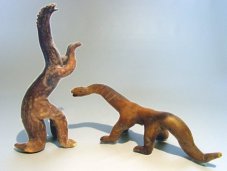
 In
1945 archeologist Waldemar Julsrud discovered clay figurines buried at
the foot of El Toro Mountain on the outskirts of Acambaro, Mexico.
Eventually over 33,000 ceramic figurines were found in the area and
identified with the Pre-classical Chupicuaro Culture (800 BC to 200
AD). The authenticity of Julsrud's find has been challenged because the
huge collection included dinosaurs. In 1954 the Mexican government sent
a team of archeologists to investigate. In 1955 Charles Hapgood,
professor of Anthropology at UNH, conducted an elaborate investigation
including extensive radiometric dating and thermoluminescent testing by
the University of Pennsylvania. In 1990 an investigation was conducted
by Neal Steedy, an archeologist who works with the Mexican government.
Thus Julsrud's work has survived numerous tests and the Mexican
government has even imprisoned two men for selling these artifacts on
the black market. Moreover, the dinosaurs are modelled in very agile,
active poses, fitting well with the latest scientific evidence and
lending credence to the artists having actually observed these
creatures. Like the Ica Stones, some sauropod's are depicted with a
distinctive spinal frill. There was extinct ice-age horse remains, the
skeleton of a woolly mammoth, and a number of ancient human skulls
found at the same location as the ceramic artifacts, validating the
antiquity of the site (Hapgood, Charles, 2000, p.82). Dr. Ivan T.
Sanderson was amazed in 1955 to find that there was an accurate
representation of a Brachiosaurus, almost totally unknown to the
general public at that time. Sanderson wrote, "This figurine is a very
fine, jet-black, polished-looking ware. It is about a foot tall. The
point is it is an absolutely perfect representation of Brachiosaurus,
known only from East Africa and North America. There are a number of
outlines of the skeletons in the standard literature but only one
fleshed out reconstruction that I have ever seen. This is exactly like
it." Further evidence of the authenticity of JulsrudÕs finds is the
near-perfect Iguanodon dinosaur figurine. This was one of the first
dinosaur skeletons discovered. The early concept of its appearance was
almost comical in the mid 1800's. By the turn of the century it had
improved considerably but fell far short of what we now know. The
Acambaro figurine exhibits knowledge we have gained only in the last
few years. No hoaxer could have made this model in the 1940's. Here is
link
where you can read more. Here's
another one. In
1945 archeologist Waldemar Julsrud discovered clay figurines buried at
the foot of El Toro Mountain on the outskirts of Acambaro, Mexico.
Eventually over 33,000 ceramic figurines were found in the area and
identified with the Pre-classical Chupicuaro Culture (800 BC to 200
AD). The authenticity of Julsrud's find has been challenged because the
huge collection included dinosaurs. In 1954 the Mexican government sent
a team of archeologists to investigate. In 1955 Charles Hapgood,
professor of Anthropology at UNH, conducted an elaborate investigation
including extensive radiometric dating and thermoluminescent testing by
the University of Pennsylvania. In 1990 an investigation was conducted
by Neal Steedy, an archeologist who works with the Mexican government.
Thus Julsrud's work has survived numerous tests and the Mexican
government has even imprisoned two men for selling these artifacts on
the black market. Moreover, the dinosaurs are modelled in very agile,
active poses, fitting well with the latest scientific evidence and
lending credence to the artists having actually observed these
creatures. Like the Ica Stones, some sauropod's are depicted with a
distinctive spinal frill. There was extinct ice-age horse remains, the
skeleton of a woolly mammoth, and a number of ancient human skulls
found at the same location as the ceramic artifacts, validating the
antiquity of the site (Hapgood, Charles, 2000, p.82). Dr. Ivan T.
Sanderson was amazed in 1955 to find that there was an accurate
representation of a Brachiosaurus, almost totally unknown to the
general public at that time. Sanderson wrote, "This figurine is a very
fine, jet-black, polished-looking ware. It is about a foot tall. The
point is it is an absolutely perfect representation of Brachiosaurus,
known only from East Africa and North America. There are a number of
outlines of the skeletons in the standard literature but only one
fleshed out reconstruction that I have ever seen. This is exactly like
it." Further evidence of the authenticity of JulsrudÕs finds is the
near-perfect Iguanodon dinosaur figurine. This was one of the first
dinosaur skeletons discovered. The early concept of its appearance was
almost comical in the mid 1800's. By the turn of the century it had
improved considerably but fell far short of what we now know. The
Acambaro figurine exhibits knowledge we have gained only in the last
few years. No hoaxer could have made this model in the 1940's. Here is
link
where you can read more. Here's
another one.
 To
the right is an artifact from Tiwanaku, an important Pre-Columbian
archaeological site in Bolivia. Tiwanaku is recognized by Andean
scholars as one of the most important precursors to the Inca Empire.
The sculptor depicted a dinosaur-like creature at least 800 years
before European scientists discovered dinosaurs. To
the right is an artifact from Tiwanaku, an important Pre-Columbian
archaeological site in Bolivia. Tiwanaku is recognized by Andean
scholars as one of the most important precursors to the Inca Empire.
The sculptor depicted a dinosaur-like creature at least 800 years
before European scientists discovered dinosaurs.
 "In
the 1960's, a leading jewel designer called Emanuel Staub was
commissioned by the University of Pennsylvania...to produce replicas of
a series of small gold weights obtained in Ghana. ...So well crafted
were they that the animals that they depicted could be instantly
identified by zoologists--all but one, that is, which could not be
satisfactorily reconciled with any known animal, until Staub saw it."
(Shuker, Dr. Karl P.N., In Search of Prehistoric Survivors,
1995, p. 20.) Originally photographed resting on its hind legs (as if
bipedal), this enigmatic Ashanti gold figurine was difficult to
identify. Once properly positioned, Staub noted that the mysterious
artifact bears a striking resemblance to a dinosaur. Perhaps this
figurine was an attempt to model the sauropod Mokele-mbembe creature
that is said to inhabit remote regions of equatorial Africa still
today. "In
the 1960's, a leading jewel designer called Emanuel Staub was
commissioned by the University of Pennsylvania...to produce replicas of
a series of small gold weights obtained in Ghana. ...So well crafted
were they that the animals that they depicted could be instantly
identified by zoologists--all but one, that is, which could not be
satisfactorily reconciled with any known animal, until Staub saw it."
(Shuker, Dr. Karl P.N., In Search of Prehistoric Survivors,
1995, p. 20.) Originally photographed resting on its hind legs (as if
bipedal), this enigmatic Ashanti gold figurine was difficult to
identify. Once properly positioned, Staub noted that the mysterious
artifact bears a striking resemblance to a dinosaur. Perhaps this
figurine was an attempt to model the sauropod Mokele-mbembe creature
that is said to inhabit remote regions of equatorial Africa still
today.
At a museum in Manitou Springs, Colorado, there is an unusual
carved artifact. It is an Indian prayer stick (see below left), roughly
a foot long, with a crested head, eyes on both sides, and beaked mouth.
The beautiful artistic work stands out as strikingly like a
pterodactyl! This portrayal from a Saxon shield mount reveals a
pterosaur-like creature at rest. The wings are folded back along its
scale-like sides, a long beak full of teeth, crest, and an unmistakable
tail vane all make the depiction compelling. The wings are folded back
along its scale-like sides, a long beak full of teeth, crest, and an
unmistakable tail vane all make the depiction compelling.The flying
reptile widfloga (or far-ranging flyer) was known to the Saxons
and this shield-boss came from the Sutton Hoo burial site. It is
displayed at the British Museum (click to enlarge).

 Some of the beautiful French chateaus built at
the close of the Middle Ages and early 1500's have dramatic dragon
illustrations carved into their walls, ceilings, and furniture. These
include Château de Chambord, Château de Blois, and Château
Azay-le-Rideau. Note the similarities in the dinosaurian-like dragons
and their resemblance to dinosaurs like Plateosaurus and
Thecodontosaurus. The Château Azay-le-Rideau also displays a
fascinating tapestry depicting what looks like a pterosaur fighting a
(click to enlarge). A tapestry at Château de Blois portrays a dragon
(and its baby) with gnarly horns on its head that are reminiscent of
the dinosaur Dracorex hogwartsia (click to enlarge).
Some of the beautiful French chateaus built at
the close of the Middle Ages and early 1500's have dramatic dragon
illustrations carved into their walls, ceilings, and furniture. These
include Château de Chambord, Château de Blois, and Château
Azay-le-Rideau. Note the similarities in the dinosaurian-like dragons
and their resemblance to dinosaurs like Plateosaurus and
Thecodontosaurus. The Château Azay-le-Rideau also displays a
fascinating tapestry depicting what looks like a pterosaur fighting a
(click to enlarge). A tapestry at Château de Blois portrays a dragon
(and its baby) with gnarly horns on its head that are reminiscent of
the dinosaur Dracorex hogwartsia (click to enlarge).
 Another pterosaur-like depiction from the Middle Ages is shown in Athanasius Kircher's 1678 book Mundus Subterraneus. This drawing is so compelling that Peter Wellnhofer (The Illustrated Encyclopedia of Pterosaurs, 1991, p. 20.) suggests it might have been based on fossil finds. But it is more likely based on even more ancient reports.
 In Kircher's book, the character Winkelried was supposed to have killed
the dragon in Switzerland during the earliest days of his particular
settlement. The most obvious anatomical discrepancy with pterosaurs
(the front feet) was a more recent addition to dragon depictions. G. E.
Smith's 1919 book The Evolution of the Dragon
explains that ancient notions only included a snake-like body, leathery
wings like a bat, and two legs. The front legs were not added till the
16th century. Kircher also includes a picture of a dragon (on left)
that resembles the rhamphorynchoid pterosaurs.
In Kircher's book, the character Winkelried was supposed to have killed
the dragon in Switzerland during the earliest days of his particular
settlement. The most obvious anatomical discrepancy with pterosaurs
(the front feet) was a more recent addition to dragon depictions. G. E.
Smith's 1919 book The Evolution of the Dragon
explains that ancient notions only included a snake-like body, leathery
wings like a bat, and two legs. The front legs were not added till the
16th century. Kircher also includes a picture of a dragon (on left)
that resembles the rhamphorynchoid pterosaurs.
 According
to the Greek mythology a heroic figure named Jason, son of Aeson,
captured a golden fleece that was guarded by a hissing dragon. This
legend of Jason charming the Dragon is memorialized in a beautiful
painting (see left) by the multi-talented European artist Salvator Rosa
(1615-1673). It is remarkable in its likeness to a pterosaurian. From
where did Rosa get this inspiration? According
to the Greek mythology a heroic figure named Jason, son of Aeson,
captured a golden fleece that was guarded by a hissing dragon. This
legend of Jason charming the Dragon is memorialized in a beautiful
painting (see left) by the multi-talented European artist Salvator Rosa
(1615-1673). It is remarkable in its likeness to a pterosaurian. From
where did Rosa get this inspiration?

 In
1496 the Bishop of Carlisle, Richard Bell, was buried in Carlisle
Cathedral in the U.K. The tomb is inlaid with brass, with various
animals engraved upon it (see right). Although worn by the countless
feet that walked over it since the Middle Ages, a particular depiction
is unmistakable in its similarity to a dinosaur. Amongst the birds,
dog, eel, etc. this clear representation of two long-necked creatures
should be considered evidence that man and dinosaurs co-existed. In
1496 the Bishop of Carlisle, Richard Bell, was buried in Carlisle
Cathedral in the U.K. The tomb is inlaid with brass, with various
animals engraved upon it (see right). Although worn by the countless
feet that walked over it since the Middle Ages, a particular depiction
is unmistakable in its similarity to a dinosaur. Amongst the birds,
dog, eel, etc. this clear representation of two long-necked creatures
should be considered evidence that man and dinosaurs co-existed.
One would think that such hard evidence would be highly problematic
for evolutionary theory. Indeed Dr. Philip Kitcher, in his
anti-creationist book Abusing Science, claims that solid
evidence that dinosaurs and man co-existed would "shake the foundations
of evolutionary theory." (1998, p. 121) Likewise, Strahler insists that
"it is conceivable that a scientist will some day discover human bones
among dinosaur bones in such a relationship that it is judged highly
likely that humans and dinosaurs lived at the same time. Such a finding
would deal a crushing blow to the widely favored hypothesis of a unique
evolutionary sequence. In Popper language, the hypothesis of evolution
would be falsified." (Strahler, Arthur N., Science and Earth History: The Evolution /Creation Controversy,
1999, p. 17.) Unfortunately the history of Darwinian theories suggests
that all such evidence would quickly be assimilated into evolution
theory. But one can at least hope that as more evidence comes to light,
the credibility of the evolutionary story-tellers will at last wear
thin!It seems that everywhere we look, we find
things that contradict the "scientific orthodoxy" of today. But the
scientific establishment will never, ever acknowledge or admit to these
artefacts as being authentic. To do so would be to admit that they are
completely wrong about our origins and thus all of the text books used to
indoctrinate out children with. This is unacceptable to them, so we will
never expect them to do so. Only the return of the Lord Jesus Christ will
cause them to admit to the truth. But the Bible says they will mourn when
this happens:
"At that time the sign of the Son of Man will
appear in the sky, and all the nations of the earth will mourn. They
will see the Son of Man coming on the clouds of the sky, with power and
great glory." --Matthew 24:30
I highly recommend watching the video below after viewing
this page, as it presents many other facts and pictures which the evolutionists
don't want you to see.
Watch this incredibly informative video as
Dr. Hovind
traces the Biblical and historical references to dinosaurs
Watch the Video
|